1. A PLACE WITH A STORY…

Some places are built. Others are gathered, slowly, from the lives, memories and meals that happened within their walls.
Harvest Table is one of those places.
Our story begins long before the first plate was served — with an old mill beside the Breede River, a mountain pass, a few stubborn dreams, and a love of food and hospitality that has travelled through more than one lifetime.
This is the story of where we came from, the places and people who shaped us, and how all those threads eventually came together around one very big table.

THE MILL THAT CAME BEFORE US

BEFORE HARVEST TABLE

Long before Harvest Table welcomed its first guests, these walls belonged to a working wheat mill.

The Old Ceres Mill stood beside the Breede River, part of the landscape and daily life of the valley. Grain came in, the great wooden machinery turned, and food made its way from this place to the tables of the people who lived here.

The mill itself formed part of a much older story. The Inn stands on the original foundations of Jan Mostert’s 18th-century homestead, one of the early landmarks along the difficult route through the mountains towards Ceres.

THE ROAD THROUGH THE MOUNTAINS

In 1765, Mostert’s Hoek Pass became the first access route into the valley. It was a gruelling journey. Wagons had to be dismantled and carried over the mountains in places, before being reassembled on the other side.

Almost eighty years later, Andrew Geddes-Bain and his team of convicts completed Michell’s Pass, transforming the journey and opening the valley to a much greater flow of people and trade.

A CROSSROADS IN THE VALLEY

And so the landscape around the mill was never merely scenery. It was a crossroads — of travellers, farmers, food, stories and changing fortunes.

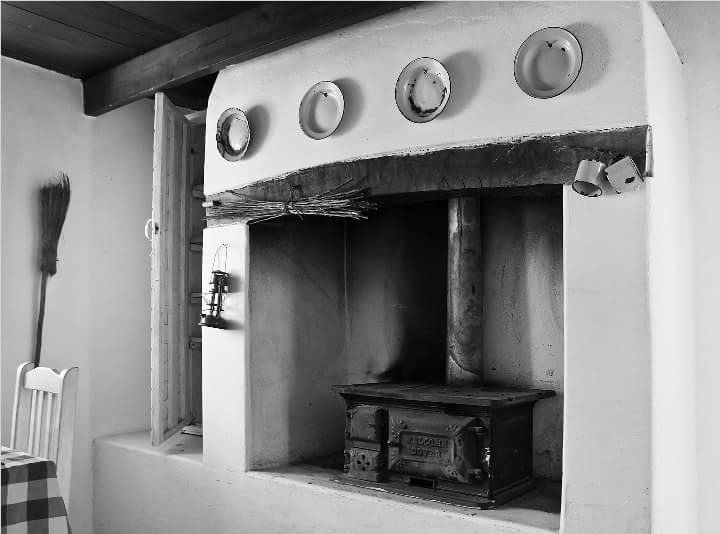
Some of the old machinery remains. The milling stone is still displayed at the top of the veranda stairs, while the historic wooden cog-work has been preserved inside the bistro. The gears are worn and darkened by time, but they are perhaps the most tangible reminder that this was once a place of work – a place where grain became flour, and flour became food.

STORIES THAT STAYED

The property itself continued to gather stories long after the mill fell silent. Records of it operating as an inn or hotel date back as far as 1901. Legend has it that Paul Kruger was among the notable guests who once stayed here.

After the Second World War, the property was owned by Pieter Graaff, cousin of Sir De Villiers Graaff, who reportedly attempted to farm trout for Cape Town’s famous Mount Nelson Hotel – until otters from the Breede River apparently put an end to that particular venture.

SA’S “FIRST BRIE CHEESE”

Later, in the late 1970s, the Elze family ran a dairy here. According to local accounts, the farm produced what is said to have been the first Brie cheese made in South Africa.

The property has worn many names and served many purposes since those early days. For 13 years it was known as Mill & Oaks. In 2012, it opened a new chapter as Winterberg Mountain Inn & Harvest Table Bistro.

But perhaps that is what makes an old place special.
Buildings change. Businesses come and go. The people around the table change too.

The story continues.
THE VALLEY, THE PASS & THE PEOPLE

The history of the Ceres Valley is inseparable from the mountains that surround it. Long before roads were engineered through the Witzenberg, routes across the mountains followed older paths used by the Khoekhoen and San. Stock farmers were crossing the Witzenberg range by the early 18th century, establishing themselves in the Warm and Cold Bokkeveld.

For those who came later, getting through the mountains was no easy journey. In 1765, Jan Mostert of the farm Wolvenkloof built Mostertshoek Pass. The route was so steep and difficult that wagons had to be dismantled and carried over parts of the mountain. It remained the main route into the valley until a new pass changed everything.

Between 1846 and 1848, Andrew Geddes Bain built Michell’s Pass. Named after Charles Michell, then Surveyor-General of the Cape Colony, it opened Ceres to much easier movement of people, wagons and goods. Ceres was formally established in 1849, and the completion of the pass helped turn the settlement into an important transport point.

Then came the diamonds.
When diamonds were discovered, the road through Ceres became one of the principal routes north towards the Diamond Fields. Transport riders became an important part of the town’s economy, carrying people and goods through Michell’s Pass. The very name Togryers Museum reflects how important that transport trade became to Ceres.

The railway eventually reached Ceres in 1912, changing the way goods and people moved through the region once again.

Agriculture would become increasingly important to the valley, but the old pattern remained: people arrived, passed through, traded, settled, worked and made their lives here.

And that is really the history we inherit around the old mill: not simply a building standing beside a river, but a place shaped by movement — of people, animals, wagons, grain, goods and stories.

Our Story
There is a golden thread running through the last few decades of our lives: newspapers, restaurants, hospitality, baboons, old buildings with stories to tell, and the Breede River that somehow keeps turning up wherever we do.
In 2009, after 13 years in journalism and publishing, we bought Tolhuis Restaurant in Michell’s Pass. We had spent the years before that in Port Elizabeth, working at Die Burger and Die Son, where our son Simon was born, but the idea of owning a restaurant had been sitting somewhere in the back of our minds for years.
When the opportunity presented itself to buy the old Tolhuis Restaurant, we didn’t need much convincing.
The iconic national heritage building already had a story of its own, and the tiny restaurant tucked behind it could accommodate fewer than 30 people indoors. To us, that was more than enough. We had found ourselves a new happy place.
Reint took over the kitchen while Karien became the very people-oriented face of the restaurant out front, and because Tolhuis was so firmly rooted in the history of Michell’s Pass and Ceres, the food needed to feel as though it belonged there too.
Roosterkoeke, lamb pies, snoek tart, and other generous South African favourites became part of what we served, with the old building, the mountain, and the river providing a backdrop that no restaurant designer could ever have recreated.
The Breede River was particularly significant. We had first found ourselves beside it in 1996, when we moved to Robertson and started Breederivier Gazette, a community newspaper, and from then on the river seemed to become a permanent character in our lives.
By the time we arrived at Tolhuis in 2009, it had almost become a guest at our tables, and it has remained one ever since. So have the baboons, although they have never been particularly well-behaved guests.
In 2011, the old Mill & Oaks Country Inn came onto our radar and, naturally, we bought that too. We renamed it Winterberg Mountain Inn, with Harvest Table Bistro its in-house restaurant. It was the beginning of the chapter that would eventually become our main focus, although at the time we had no idea quite how many other adventures were still waiting around the corner.
In 2016, a beautifully positioned shop became available in Ceres’ main street and we decided that what the town really needed was an Italian restaurant. So came Capish!, our next foray into hospitality and another opportunity to feed people, meet people, and probably take on more work than was entirely sensible.
There were other adventures along the way. We became involved with friends in the reopening of Tulbagh’s iconic Paddagang Restaurant, and after 2020 Reint opened a pop-up gastropub and street-food café in the historic Saronsberg Theatre building in Tulbagh. It was called Kunskombuis, and for a while it seemed that we had perfected the art of having several restaurants and hospitality projects going at the same time.
Then the Covid pandemic arrived and changed the rules completely.
The economic consequences for hospitality were brutal, and eventually Tolhuis closed in 2019, while Kunskombuis followed in 2021. The pandemic forced us to look hard at what we were doing and, perhaps for the first time, admit that we had simply had too many irons in the fire.
When the dust settled, we decided to concentrate on what remained: Winterberg Mountain Inn and Harvest Table Bistro.
Looking back, it feels less like a collection of separate restaurants and more like one long, slightly chaotic journey. Since 1996, the constants in our lives have been the newspaper business, the Breede River, restaurants and hospitality, a weakness for iconic heritage buildings, and, inevitably, the baboons.
The buildings have changed, the menus have changed, and some of the restaurants have disappeared into history, but the things that made us fall in love with this part of the world have remained.
The river still runs past us. The kitchen is still busy. There are still stories around the tables. And somewhere nearby, there is almost certainly a baboon waiting to see what we are cooking.